Moving at the Speed of Trust: A Profile of Lone Piñon
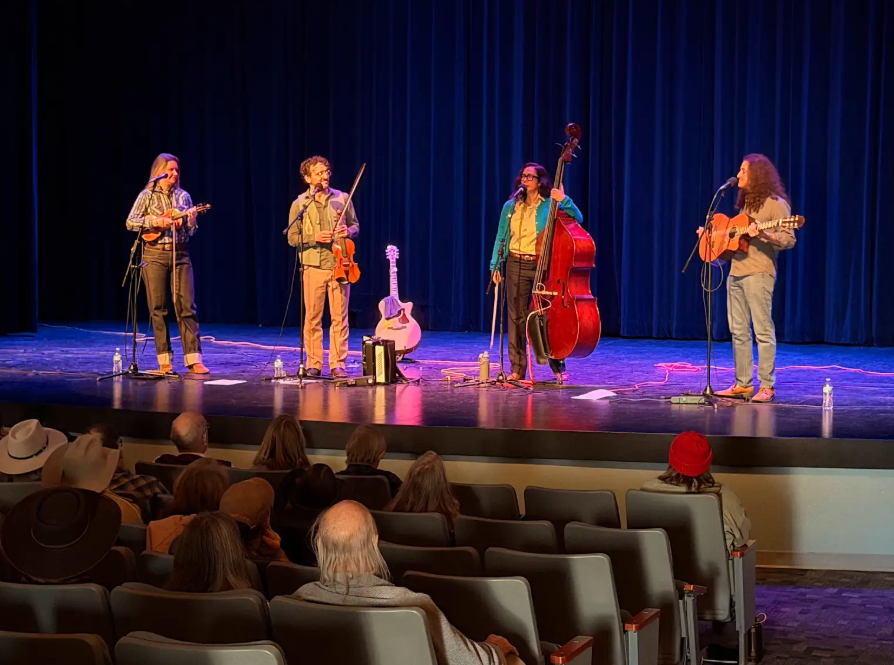
Photograph by Jeremy Ellis, Great Basin College.
By Katie Karnehm-Esh
If you ask who Lone Piñon is, some might say a musical group from New Mexico. Others might say they are a dance band. Still others might say they are folk music educators. But when I first heard them play at the National Cowboy Poetry Gathering, I would have said they were the single greatest hour of delight I’d experienced in 2026.
Lone Piñon is a New Mexican string band, or orquesta típica, made up of Tanya Nuñez (upright bass, guitar, vocals), Karina Wilson (violin, viola, vocals), Santiago Romero (guitar, vihuela, vocals), and Jordan Wax, original founding member (violin, piano, accordions, mandolin, guitar, vocals). Jordan grew up in Missouri, while Tanya, Karina, and Santiago are New Mexican natives. All four band members grew up under the tutelage of folk-music elders. Individually, they are well-known for their musical talents. As a group, they have created an ensemble so distinctive and fun that they have fans from Elko to Alaska to Louisiana.
The band gathers around a computer screen in their Santa Fe kitchen during a rehearsal break. When I ask where they got their name, Jordan pops into the frame of their camera and says it was the name of a storage unit in the neighborhood. At one point the land was a sheep field with a lone piñon tree that became a local landmark. When the field became an auto repair shop, the owners named it Lone Piñon, and kept the name when the repair shop became a storage unit. Even after the storage unit was bought out by a national chain, the name stuck, turning into “Just Around the Corner–Lone Piñon.” A past band member had suggested that ‘Lone Piñon would be a great band name.’ It turned out to be a perfect band name, as the land was owned by the cousins of their mentor Tomas Maes, who has been a key source of their musical knowledge. The family, Jordan says, has been a big supporter of their music, and loves that they have this connection.
Noticing historical patterns like these are part of the band’s gift. Another is people. During our interview, the band members talk about the lengths they went to to have their documentary film include New Mexican Spanish dialect subtitles for Tomas, their mentor. They talk about a mutual friend of ours from Elko who died unexpectedly right after the Gathering. And they continually refer back to their audiences, and how their listeners shape the performances with them.
When I ask how their music fits into the National Cowboy Poetry Gathering, Karina says, “Well we yodel!” before adding that working the land, and caring for livestock are pivotal aspects of New Mexican tradition. “The storytelling too,” Santiago says.
Lone Piñon alternately describes their music like a living research project, a tapestry, or a soil sample that shows the historical and culture layers. When I ask about their process, Karina says, “I picture it as a rock tumbler.” One band member will bring in a piece of music or an idea. “We try to listen for things that would make it more interesting,” Karina says, adding chord progressions and musical ideas, “then tumble until it’s something sparkly gorgeous.”
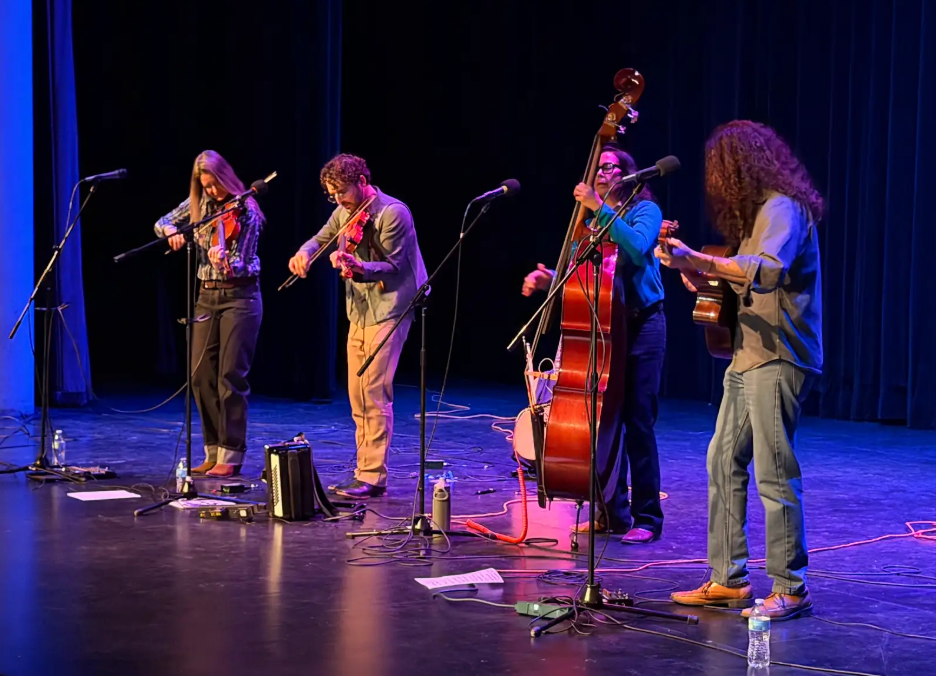
Photograph by Jeremy Ellis, Great Basin College.
“We also bring our own sensibilities to [the music],” Jordan says, adding they don’t want their performance to be a museum piece, but “to sound like only the four of us could have made it.” He also wants the audience to hear each of them in the music. “When a tradition is being played in that way where you really can feel the personality and the lives of the people who are playing it,” he says, “that gives it a really important life force and blood in the veins.”
Santiago adds a pivotal ethos has been an idea they call “moving at the speed of trust.” The band describes this as crafting music so that the listeners trust where the band is taking them, like stepping stones leading the listeners to each new section of music. Most of the pieces come from a dance tradition, which, as Jordan points out, adds a performance challenge; the audiences are usually sitting, not dancing. The work is on the musicians to help the audience “experience these amazing songs like we do.”
Listen to their new album Hot Carne Seca (“It’s tasty,” Santiago says) and you will hear what Jordan means. Santiago has a distinct operatic belt. Karina and Tanya croon, strum, and fiddle. Jordan stitches the music together with a rotation of instruments and his voice. They recorded the album in Louisiana with a Cajun musician who specializes in capturing the essence of live music. While a few songs on the album are ballads, most are infectious dance numbers. Ninety percent of the songs are in Spanish, but fear not if you are monolingual: your feet will know what to do.
The band has performed everywhere from living rooms to festivals of 40,000 people, and love them all. Tanya says, “If I look around and everyone looks like they’re having a hell of a good time–which feels like every time now–that’s feeding into joy and resistance. Active resistance. Experiencing joy through music is everything to me.”
“We bring what we bring, and the community brings something,” Jordan says.
Joy and resistance go together for Lone Piñon, as they do for so many folk traditions. “Same ingredients, different combination,” Jordan says. He says the Creole and Cajun cultures of Louisiana, and traditional music of Hawaiʻi are interesting parallels to New Mexico folk music, as those communities also had to struggle to maintain their language and resist racist policies. Traditional styles, he says, have long resisted colonialism.
This issue has taken on a more serious note in 2026, and adds to the challenges of the job. In addition to the complications of travel with multiple instruments, and an artistic economy sharing fewer resources, current immigration policies are a constant stressor.
“It’s a changing landscape for our audience,” Karina says, noting they usually sing in Spanish to a Spanish-speaking audience. “Just a few years ago, we would have been really excited to go to a place like Chicago. Now more and more people are in hiding, which I never would have thought would be the case in this country.”
“The work is more important than ever,” Jordan says, “but it’s also harder than ever. It’s a change in my life as a cultural worker. But because it’s needed, it’s going to continue.”
As we wrap up, I ask if there’s anything else I should know. Tanya yells, “We love Elko!”
“Can you tell me why?” I ask.
Their answers range from The Star, the legendary Basque restaurant in town, to the love the community brings to their shows. “I guess we should say we love Elko, and the National Cowboy Poetry Gathering,” Jordan says. “We imagine that Elko is like this every day.”
Could it be? I spend a lot of time in my work advocating for the importance of the humanities, especially in towns like Elko. A lot of this work feels like a marathon. Maybe it doesn’t have to be this way though. Maybe the solution is dance steps and fiddle music and occasional, joyous, yodeling.
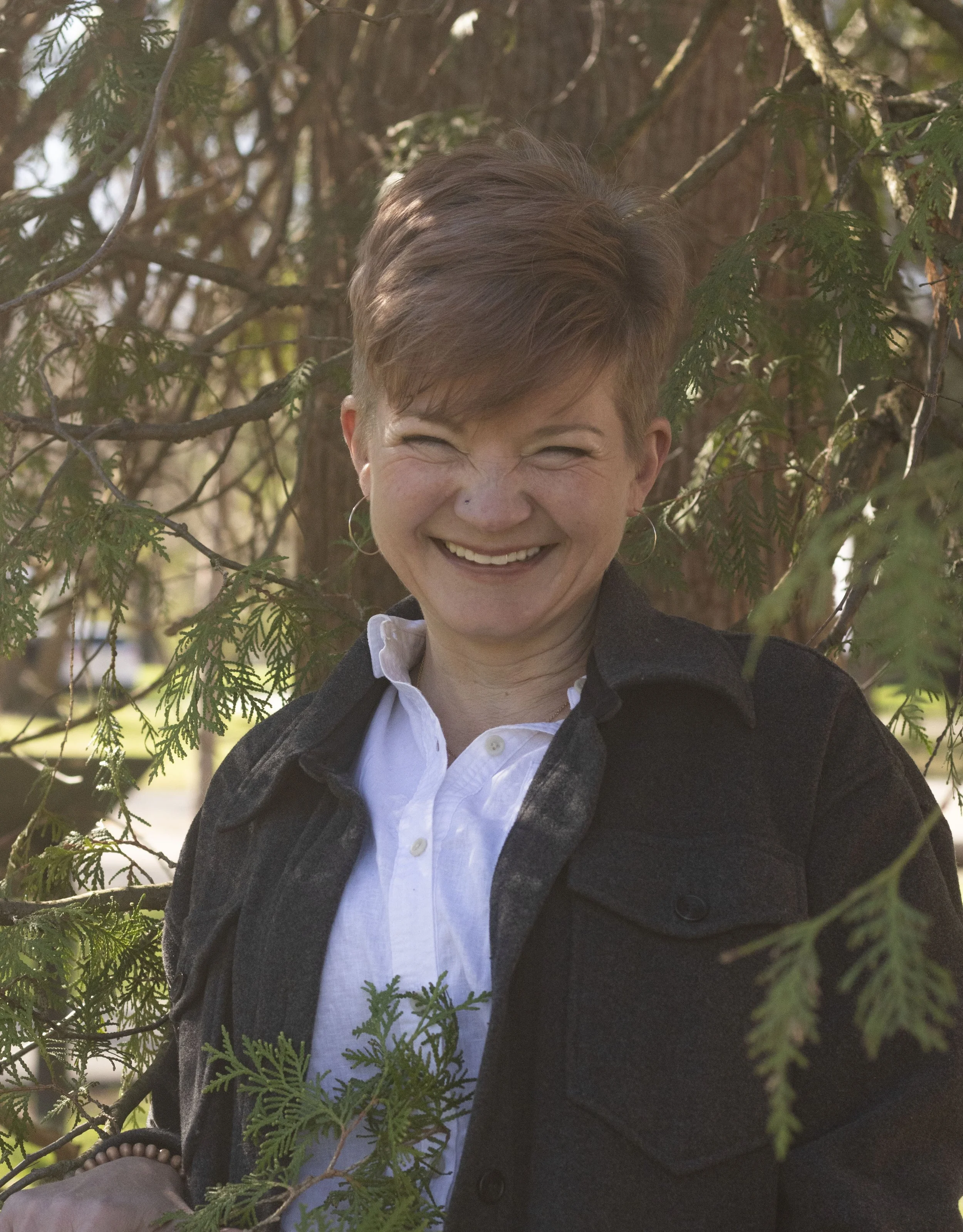
Katie Karnehm-Esh, Ph.D, is the Humanities Center Coordinator at Great Basin College in Elko, Nevada, as well as a writer, educator, and editor. An Ohio native, she did her graduate work in creative writing at the University of St. Andrews, Scotland, and taught undergraduate English in Indiana for sixteen years before relocating to Nevada. She has been a participant at Vermont Studio Center, Kenyon Review Writers Workshops and Breadloaf Environmental Writer Workshops; recently she was awarded a Fulbright to Queens University, Belfast, for the 2027 year. Her writing has been published in literary journals such as Fourth Genre, The Whale Road Review, and The Englewood Review. She is currently working on a creative nonfiction book about the US national parks.